
Written by Ty Lagace, BA, BSW Candidate
Mental Health Awareness Week 2024 is May 6th to 12th and themed to promote healing through compassion. This annual event aims to promote and celebrate the importance of mental health and building connections with others.
Chroma NB reached out to Nat Young, a Master of Psychology Student and intern at JustUs; We All Struggle Inc. to chat about the importance of mental health awareness, the intersections of 2SLGBTQIA+ experiences and mental health, and some of their thoughts on providing mental health care.
“I have always been fascinated with this idea of a ‘compassionate other’. I was a very observant person growing up and always the ‘wise beyond her years’ child. I have just always been interested in people’s experiences, their development, and their interactions.”
Nat attributes the connection of their interests and counselling to their own experiences as a service user;
“It wasn’t until I had my own queer therapist that I realised how all of my natural interests could manifest into something truly meaningful. I remember learning about Carl Rogers for the first time by my own therapist and being so taken in by this idea that if everyone could be empathetic, unconditionally accepting, and be in alignment with their ideal self, the world would be a much better place. I knew I couldn’t make the world like that, but I knew I could try my hardest to be that person for others.”
Within the landscape of mental health services, this pursuit of empathetic acceptance is especially important for 2SLGBTQIA+ folks, but there are barriers to achieving such a goal;
“Something that jumps out to me is the challenge to find queer folx in roles such as therapists. For people in the queer community, it can be especially valuable to connect with someone who shares similar experiences as them; this might mean finding a therapist that visibly signals their queerness. Ultimately, it’s about finding someone who understands or even shares in your experiences,” says Young.
These barriers are not limited to entering the counselling profession, but also in the everyday experiences of 2SLGBTQIA+ folks;
“A common challenge I see being experienced by queer folx is the anxiety and stress when it comes to presenting as their authentic selves. This fear can stem from past experiences of discrimination, rejection, or harassment based on their identity. The potential for being perceived or confronted in a negative way can be a source of significant stress and apprehension. This is only exacerbated by societal stigma and lack of understanding. There is a real fear of being harmed or confronted for one’s queerness and this is true for myself at times.”
Where there are external sources to these barriers, instilling self-worth through acts of compassion, acceptance, and connecting with others is an excellent starting point for individuals. This process takes place both in our relationships with others and within ourselves. Young highlights the roles of compassion and exploring one’s past to connect with one’s identities and each other;
“Compassion is at the heart of what I do as a graduate intern. More often than not, what we humans need is someone to accept us unconditionally, listen intentionally and have compassion for what we experience in our lives. For queer folx, exploring our pasts can also help us understand the intersectionality of our identities, allowing us to better navigate our relationships with others and advocate for our needs,” Young goes on to summarise the importance of this process for queer folx in reconciling identities when facing barriers to acceptance in our world.
As a final thought, Young describes their experience as a queer person providing care for queer folks as a privilege and honour due to the trusting relationships built with service users;
“I think of the young people who make the difficult decision to leave their families for their own safety after coming out. That young person may never trust their parents, siblings, guardians and the people close to them. Having that person’s trust and to be a support person for them is my privilege.”
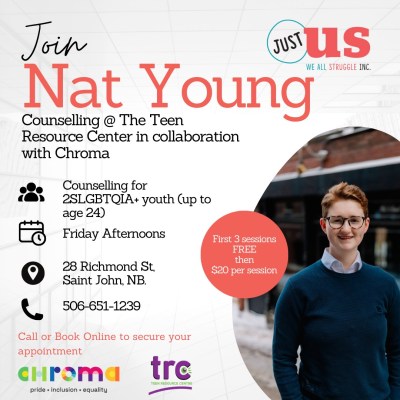
For more information about Mental Health Awareness Week, please visit the Canadian Mental Health Association’s website. If you, or someone you know is seeking mental health support, you can find Nat Young through Just Us, We All Struggle Inc. at https://www.justusinc.ca/ for virtual or in-person options. As well as at the Just Us office, Nat offers in-person counselling sessions for youth under 25 at the Teen Resource Center in Saint John on Friday afternoons. Their first three counselling sessions are free, and then become $20/session. Virtual sessions are $20.
For immediate support:
Kids Help Phone: 1-800-688-6868 (Call or Text)
Mobile Mental Health Crisis Service 1-888-811-3664
CHIMO Suicide Crisis Line 1-800-667-5005
LGBTQ Youth Line Call 1-800-268-9688 or Text 647-694-4275
Trans Lifeline 1-877-330-6366
Horizon Health Network Mobile Crisis Unit 1-888-811-3664